COM4008: Demonstrate a knowledge and understanding of databases and data management systems- Introduction to Databases, Assignment ,
Assignment Brief
As part of the formal assessment for the programme you are required to submit a Introduction to Databases assignment. Please refer to your Student Handbook for full details of the programme assessment scheme and general information on preparing and submitting assignments.
Learning Outcomes:
After completing the module, you should be able to:
- Demonstrate a knowledge and understanding of databases and data management systems.
- Understand key principles of relational database design techniques.
- Apply knowledge and understanding of database design and development to design, implement, and test a relational database solution for a given scenario.
- Graduate Attribute: Discipline Expertise: Knowledge and understanding of chosen field. Possess a range of skills to operate within this sector, have a keen awareness of current developments in working practice being well positioned to respond to change.
Assignment Task
Scenario:
ReadIT is a small library in Woodley which is ran by the local community to encourage reading. Due to its success, they are now requiring a database to store and track book loans. They are also planning to start a coffee shop so that any profits can help cover the expenses of the library.
You have been assigned as a database developer to undertake the following:
- Task 1: Propose the design of a relational database for the coffee shop
- Task 2: Implement the database for the community library.
- Task 3: Test the implementation of the community library database
Part 1: Database Design and Development
Task 1: Coffee Shop Relational Database Design
The coffee shop will make fresh coffee on the premises based on customer orders. Initially, they are planning to offer 5 different varieties of coffee which can be ordered in 3 different sizes. The coffee prices will vary based on the coffee variety and the size of the selected cup. In addition, they will also sell items such as biscuits and cakes. They will need to have online catalogue for this menu along with prices.
They will also need to record the orders and print invoices.
They are hoping to increase the coffee varieties and offer other foods in the future so it is important that the database design is scalable.
a. Design the relational database for the coffee shop covering the areas listed below:
i. Logical Model For the coffee shop scenario, create a logical model for the database using a crow’s foot style Entity-Relationship diagram(e.g. Barker/UML, do NOT use the Chen diagramming style).
Make sure to normalise the data to 3NF, adding keys and identifier columns as appropriate. Annotations for the normalisation process is required. Make sure to note any assumptions made along with their reasons.
ii. Physical Model
Using your logical model as a basis, create a physical model Entity-Relationship diagram using crow’s foot notation for the relational database provided by the Arden University. Make sure to use appropriate naming conventions and to identify data types, keys, and constraints. Note any assumptions made or further changes to the structure beyond those in the logical model.
Task 2: Create the Library Relational Database
The library lends books to the local community’s registered members. Until now all information related to book stock, members and library transactions has been stored manually using a ledger. However, there have been times when the data has been inconsistent or lost and there are concerns around this manual way of processing the data so it has recommended that a database should be developed to manage all data related to the library.
a. Based on Figure 1. Library physical model entity-relationship diagram, create the database using appropriate SQL in the relational database provided by the Arden University.
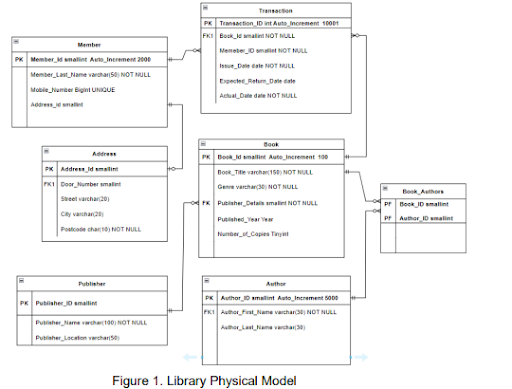
b. Insert 12 meaningful books in the Books table, 8 members in the members table and 10 library transactions for the last month. The given number of records are the minimum requirements for the database, you are allowed to add more data as required.
c. Display all the tables with the inserted data.
Provide evidence of the database creation and data insertion with appropriate execution screenshots with your database schema to verify that it is your code.
Part 2: Test the Library Relational Database
Task 3
Using the Library database from Task 2, provide solutions to the following four problem cases in the form of SQL code and a brief explanation of your reasoning. Include screenshots of SQL queries execution and its results along with your schema, evidencing this in each of the cases mentioned below. Ensure your schema or username is included in every screenshot to verify it is your code.
Case 1:
Search To demonstrate the efficiency of searching to the librarian, create searches based on the below mentioned criteria. a. Find out the specific library transaction details based on a Book Issue date. b. Find out a member based on their contact number. c. Find out the book details based on a Book title.
Case 2: Data manipulation
- A specific book has been damaged, so it needs to be removed from the stock. Delete the book from the relevant tables.
- A member has changed their contact number, please update the relevant records for the member.
Case 3: Appreciation System
- The library is eager to start a new initiative to encourage members to take good care of the books and return them on time. Add the new columns Comments and Appreciation Points in the Transaction table. Ensure it can only accept the comments and points listed below.
- Members will receive a £10 voucher based on their total appreciation points for their library transactions at the end of each year. Calculate the total Appreciation_Points for all the members; display it in the order of the highest appreciation points at the top of the results along with their member_ids.
Case 4: Statistics
- Count and display the total number of members who used the library from a selected month’s library transaction data. Use meaningful display names.