CIPD Level 5: People Management in an International Context Assignment
5OS04: People Management in an International Context
This unit equips practitioners in people management with the tools and insights needed to navigate the complexities of managing people in an international context.
CIPD’s Insight
Multinational companies are increasingly adopting integrated approaches to organize their operations globally, driven by the potential to capitalize on cross-national differences in business environments. Modern multinationals aim for a more flexible form of global integration.
Organizational culture plays a central role in the people profession. The work of HR, L&D, and OD is both influenced by and influences organizational culture because organizations are fundamentally built on human relationships and interactions. Therefore, managing and developing culture is a core aspect of the people profession.
To implement effective diversity and inclusion (D&I) strategies, organizations must take targeted actions, recognizing that inclusion is relevant to everyone in the business. Research identifies five critical areas for action:
- Employee behavior.
- Line manager capability.
- Senior leadership.
- Policies and broader people management practices.
- Organizational culture, climate, and values.
Inclusion extends beyond merely embracing diversity—it involves creating a positive work environment where individual experiences and contributions are valued, knowledge is shared, and all perspectives are respected.
Case Study
As the HR Manager for Terra-Wide, an International Property Development company, you are recognized for excelling in people management within an international context. In recognition of this success, People Management magazine has invited Terra-Wide to publish an article on the topic.
Your task is to:
- Write the article to highlight Terra-Wide’s experience and expertise in people management internationally.
- Prepare a presentation pack for People Management magazine contributors visiting Terra-Wide’s HR headquarters.
Preparation for the Tasks
- Review the indicative content for guidance and support in generating evidence.
- Ensure your work is professional, reflective, and presented in alignment with Terra-Wide`s standards.
- Leverage CIPD resources, fact sheets, and online materials to inform your assessment.
- Relate academic theories and professional practices critically and effectively, referencing key texts and publications.
Checklist:
- Complete the front cover sheet with a “wet signature” and include it at the start of your assessment.
- Use the provided bullet points as headings and subheadings for clarity.
Task One: Journal Article
Prepare a formal article for People Management magazine that showcases Terra-Wide’s expertise in international people management. The article must address the following:
Section 1: Contextual Factors and Approaches
- Examine the contextual factors of an international organization. (AC 1.1)
- Assess the drivers and benefits of employment in an international context. (AC 1.2)
- Explain convergent or divergent approaches to inform people management policy and practice. (AC 1.3)
Section 2: Function and Practices
- Evaluate the function of people practice in an international context. (AC 3.1)
- Consider how policies and practices are shaped by the international context. (AC 3.2)
Section 3: Resourcing and Cultural Considerations
- Evaluate factors in selecting and resourcing for international assignments. (AC 2.1)
- Explain why people practices vary across international boundaries. (AC 2.2)
- Evaluate cultural and institutional differences affecting international people practice. (AC 2.3)
Deliverable:
- Journal Article (Approx. 2,900 words).
Task Two: Presentation Pack
Create a presentation pack, including slides and presenter notes, on managing expatriates. The content should cover:
-
Reasons for Using Expatriates:
- Evaluate why companies employ expatriates for international assignments. (AC 4.1)
-
Expatriate Management Process:
- Explain the selection, preparation, and management of expatriates for overseas relocation. (AC 4.2)
-
Re-entry and Resettlement Support:
- Explain how people practices support expatriates returning and resettling post-assignment. (AC 4.3)
Deliverable:
- Presentation Pack: Slides and presenter notes (Approx. 1,000 words).
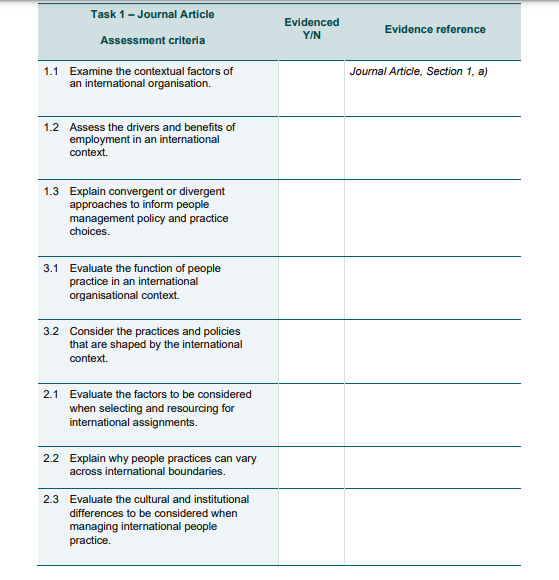
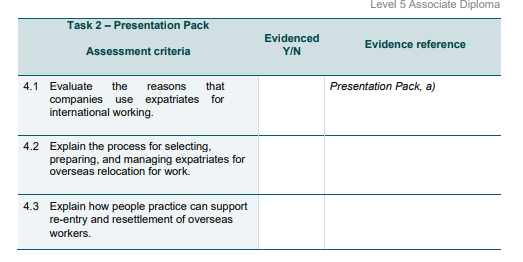
Assessment Criteria Evidence Checklist
Use the following checklist to ensure all required evidence is included. Document the title of the evidence and its location within your submission.
Assessment Grading
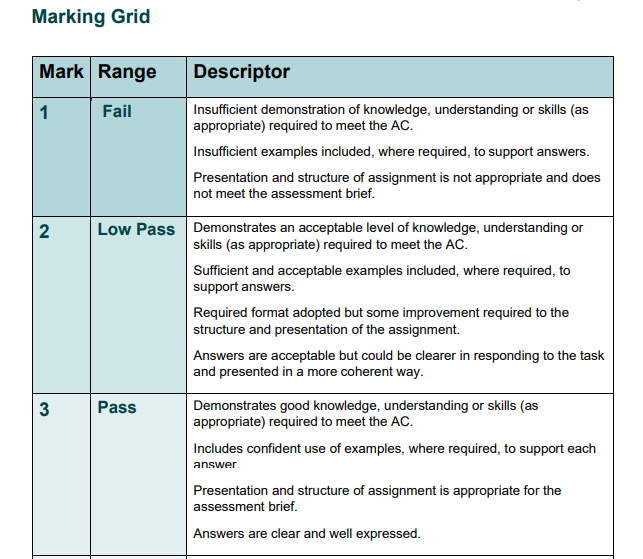
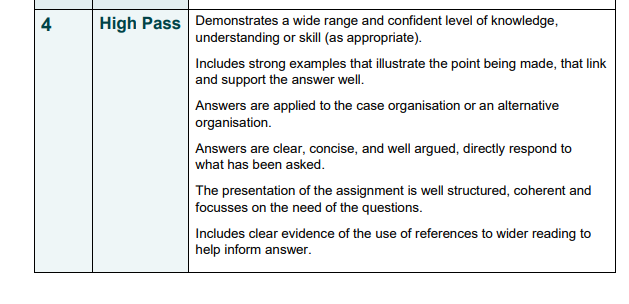
The grid below shows the range of results you could achieve based on total number of marks awarded across all assessment criteria.
To pass the unit assessment you must achieve a 2 (Low Pass) or above for each of the assessment criteria.
The overall result achieved will dictate the outcome you receive for the unit, provided NONE of the assessment criteria have been failed or referred. You will either receive a Pass or a Fail from the CIPD once the work has been moderated. The bandings below are used to indicate if your work is sitting at a low pass, pass, or high pass.